

Kelastambang: The Environment and Forestry Ministry has officially enacted Regulation No. 7/2025 on the Company Performance Rating Program in Environmental Management (Proper), introducing new criteria and processes aimed at reinforcing corporate environmental accountability.
According to the regulation, issued on August 19, 2025, the Proper program will now include a more rigorous performance assessment structure for businesses and activities that impact the environment, focusing on both compliance and voluntary initiatives exceeding regulatory obligations.
Under Article 2 of the regulation, companies are assessed not only for adherence to environmental laws but also for their proactive environmental stewardship, including green innovation, biodiversity protection, and community empowerment. “The ministry conducts development through performance evaluation and recognition in the form of Proper,” the regulation states.
The regulation outlines a four-stage implementation process: planning, implementation, ranking, and recognition. It mandates the formation of advisory and technical teams composed of government officials, academia, media, and civil society to ensure impartiality and expertise in the evaluation process.
Eligibility for participation in Proper requires businesses to have an environmental approval and meet at least one of four criteria: exporting products, being publicly listed, attracting public attention, or operating on a scale significant to environmental impact (Article 12).
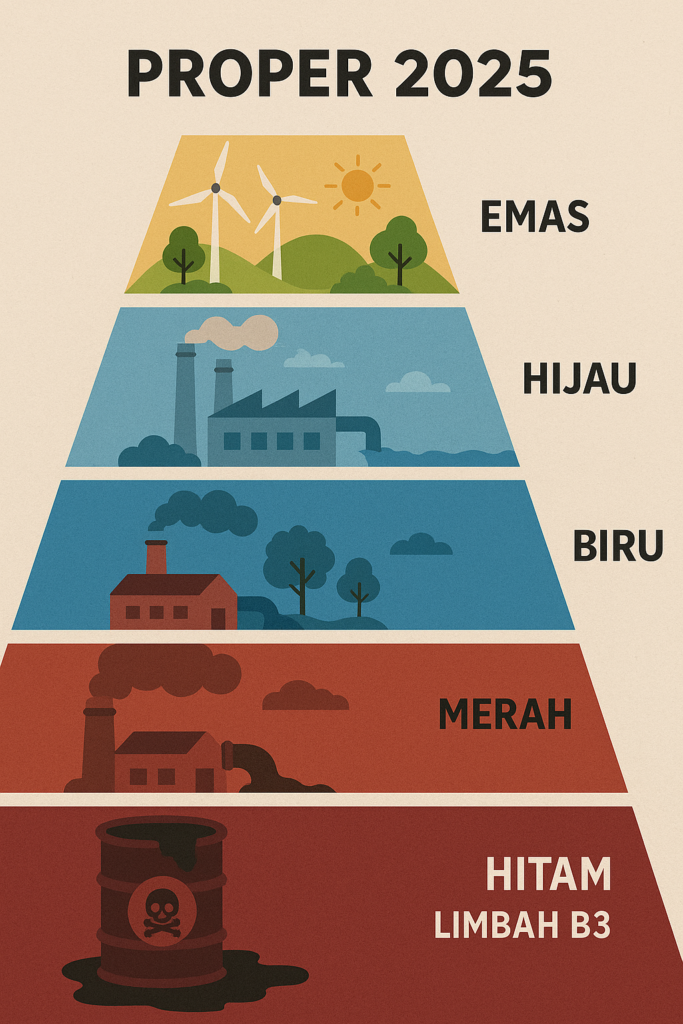
Environmental performance will be assessed through both document review and field verification, focusing on compliance with standards in areas such as wastewater management, air pollution control, hazardous waste handling, ecosystem restoration, and others (Article 17–20). Non-compliance may result in a red or black rating, prompting legal enforcement, while full compliance earns a blue rating.
For businesses that exceed mandatory compliance, the program offers green and gold rankings. Qualification for these tiers requires consistent environmental improvements, absence of administrative sanctions, community conflict resolution, and in the case of palm oil industries, membership in the national palm oil association (Article 24). Gold candidates must demonstrate leadership in green innovation and social responsibility, validated through document evaluations and presentations by top executives (Article 29).
Top-performing participants will be awarded with gold or green trophies and certificates, while consistent underperformance may result in legal action (Article 44–45). The final results may be publicly announced through print or electronic media.
This regulation replaces the previous Ministerial Regulation No. 1/2021 and marks a strategic policy shift toward integrating environmental management into corporate governance frameworks across Indonesia. The full legal basis and implementation guidance are detailed in the newly issued Regulation of the Minister of Environment/Environmental Control Agency No. 7/2025.
The PROPER Ratings Explained: Understanding the Colors
The final rating is a powerful, at-a-glance indicator of a company’s commitment to environmental stewardship.
| Rating (Color) | Official Meaning | Key Takeaway for a Learner |
| Emas (Gold) | The company has consistently demonstrated environmental excellence in its production or service processes, conducting business ethically and responsibly towards society. | You are an industry leader. You have gone far beyond what is required and are setting the benchmark for environmental and social responsibility. |
| Hijau (Green) | The company has managed its environmental impact beyond the requirements of regulations through the implementation of an environmental management system, efficient resource use, and sound social responsibility practices. | You are a high performer. You not only meet all regulations but are actively and effectively working to reduce your environmental footprint in significant ways. |
| Biru (Blue) | The company has made environmental management efforts that meet the minimum requirements of all applicable laws and regulations. | You are compliant. You are meeting the legal standard, which is the necessary foundation. This is a good baseline with a clear opportunity for further improvement. |
| Merah (Red) | The company has made environmental management efforts, but they do not yet meet the requirements of applicable laws and regulations. | Action is required. Your environmental efforts are not meeting the legal standard. You need to identify and correct these issues to achieve compliance. |
| Hitam (Black) | The company deliberately commits actions or shows negligence that result in environmental pollution and/or damage, and violates applicable laws and regulations. | Urgent intervention is needed. There are serious issues causing environmental harm that violate the law. These must be addressed immediately to avoid severe consequences. |
Key Concepts of PROPER 2025 KLH
- What is the full name and primary purpose of the PROPER program?
PROPER stands for Program Penilaian Peringkat Kinerja Perusahaan dalam Pengelolaan Lingkungan Hidup (Company Performance Rating Assessment Program in Environmental Management). Its primary purpose is to serve as a coaching program for businesses and/or activities in the field of environmental protection and management, conducted through performance evaluations and the granting of awards.
- What are the four main stages involved in the implementation of the PROPER program?
The PROPER program is organized into four distinct stages. These stages are planning (perencanaan), implementation (pelaksanaan), rating determination (penetapan peringkat), and the granting of awards (pemberian penghargaan).
- Describe the two primary implementing bodies established by the Minister/Head for the PROPER program.
The Minister/Head forms two main bodies to execute the PROPER program. The first is the PROPER Deliberation Council (Dewan Pertimbangan Proper), which includes high-ranking officials, academics, media, and NGOs. The second is the PROPER Technical Team (Tim Teknis Proper), composed of senior officials from the Ministry/BPLH responsible for policy and technical implementation.
- What are the key criteria used to screen and select companies to become PROPER participants?
A company is selected for PROPER participation if it has an Environmental Approval and meets one or more specific criteria. These criteria include producing products for export, being listed on the stock exchange, being a subject of regional or national public attention, and having a scale of activity significant enough to cause environmental impact.
- What are the two main categories of performance that are assessed for companies participating in PROPER?
The assessment is divided into two main categories. The first category evaluates the participant’s performance in complying with environmental laws and regulations across areas like water pollution, air pollution, and waste management. The second category assesses performance that exceeds the required compliance, covering aspects like environmental management systems, life cycle assessments, community empowerment, and eco-innovation.
- List the five color-coded performance ratings in PROPER and briefly explain what each signifies.
The five ratings are Gold (Emas) and Green (Hijau) for performance exceeding compliance; Blue (Biru) for companies that meet all environmental regulations; Red (Merah) for companies whose efforts do not meet regulations; and Black (Hitam) for companies that cause environmental pollution and/or damage through deliberate action or negligence.
- Under what specific circumstances is a PROPER participant subject to law enforcement action based on their rating?
Law enforcement action is initiated against a PROPER participant under two specific rating conditions. This occurs if a company receives a Red (Merah) rating for two consecutive years, or if a company receives a Black (Hitam) rating.
- What conditions must a company meet to be considered a candidate for the Green (Hijau) rating?
To be a candidate for a Green rating, a company must first achieve a “compliant” (Taat) result in its regulatory assessment. Additionally, it must show a reduction in its pollution load from the previous period, have no community conflicts, not be under administrative sanctions, and not be in the process of remediating contaminated land during the assessment period.
- Briefly outline the primary duties of the PROPER Deliberation Council (Dewan Pertimbangan) and the PROPER Technical Team (Tim Teknis).
The Deliberation Council provides advice to the Minister/Head on the PROPER program and specifically evaluates candidates for the Gold rating. The Technical Team has broader duties, including screening participants, supervising the assessment process, developing criteria, and evaluating the final ranking results before they are submitted.
- Explain the difference between the direct and indirect methods used for assessing a company’s compliance with environmental regulations.
The indirect assessment method involves the evaluation of documents, such as environmental approval documents, permits, and compliance reports submitted by the company. The direct assessment method involves on-site field verification to confirm the accuracy and truthfulness of the submitted documents and reports, ensuring that the reported data matches the actual conditions and practices at the company’s location.