

Indonesia Energy Economics and Financial Analysis (IEEFA) on Wednesday released a new report highlighting that while carbon pricing mechanisms are expanding across Asia, existing price levels remain far below what is needed to support meaningful decarbonization efforts.
The report, published on September 18, 2025, underscores that carbon prices across the region remain under US$20 per tonne of carbon dioxide equivalent (tCO₂e)—well below the US$50 to US$100/tCO₂e required by 2030 to meet global climate commitments under the Paris Agreement.
“Current carbon pricing mechanisms in the region remain below US$20 per tonne of carbon dioxide equivalent, falling short of the US$50–US$100/tCO₂e needed to align by 2030 with Paris Agreement targets,” said Ramnath N. Iyer, the report’s co-author and Sustainable Finance Lead for IEEFA Asia.
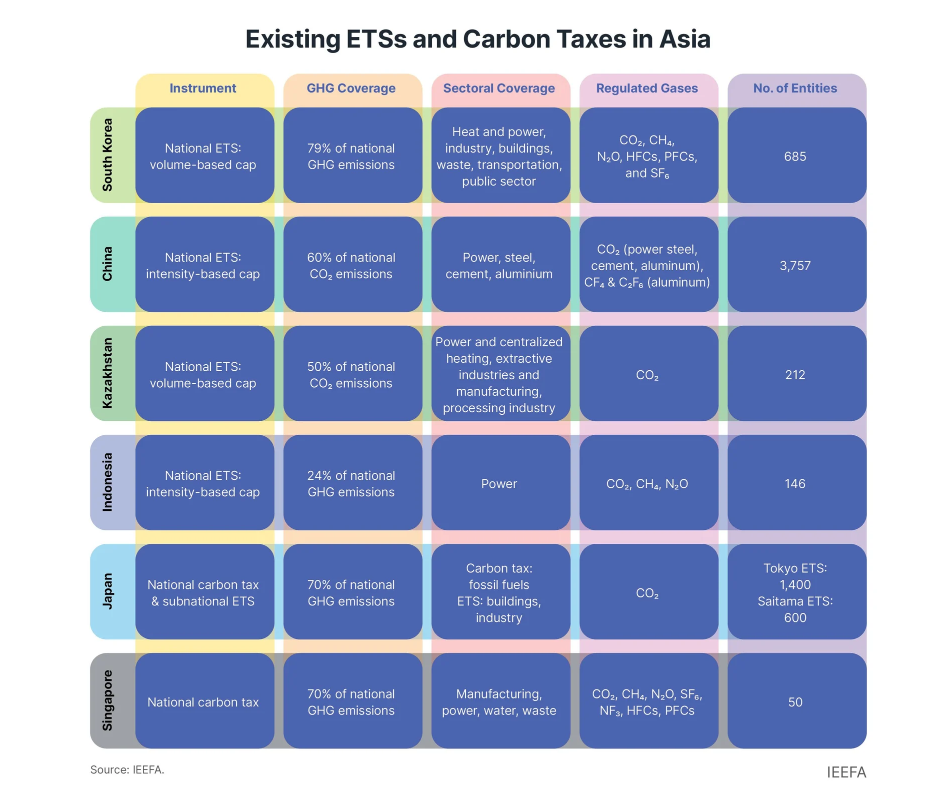
IEEFA found that despite increasing adoption of national emissions trading systems (ETSs) and carbon taxes in countries such as China, South Korea, Indonesia, and Japan, the effectiveness of these policies is being undermined by weak price signals, excessive free allocation of permits, and limited sectoral coverage.
“In the initial phases of their ETS implementation, countries like China and South Korea have generously allocated free allowances, leading to a market surplus and reduced prices. This contrasts with the European Union, which has increasingly moved towards auctioning more than 50 percent of its allowances,” said Shu Xuan Tan, co-author and Asia Sustainable Finance Analyst at IEEFA.
The report warns that systems based on emissions intensity rather than absolute caps, such as China’s national ETS, allow emissions to increase alongside economic growth. Additionally, fossil fuel subsidies across Asia, totaling US$1.25 trillion globally in 2022, continue to dilute the impact of carbon pricing.
IEEFA outlines that a phased carbon pricing strategy—starting at US$15–US$25/tCO₂e and increasing annually by US$10–US$15—would provide predictability for investors and allow time for businesses and households to adapt. Revenue generated through these mechanisms could be used to finance climate initiatives and provide social protection.
“MACs [Marginal Abatement Costs] can vary depending on factors such as location, emission intensity of the technology replaced, and period of replacement,” said Iyer. “Regardless of the particular MAC for any application, the existing carbon tax and ETS pricing regimes globally, and especially in Asia, are inadequate to address the challenge of rapid decarbonization.”
IEEFA’s analysis found that effective carbon pricing varies by sector. While a carbon price between US$10–US$30/tCO₂e may drive a shift from coal to renewables in power generation, decarbonizing high-emission sectors such as aviation and industrial manufacturing requires prices exceeding US$100/tCO₂e—rising to as much as US$550/tCO₂e for sustainable aviation fuel.
The report also notes that coverage remains uneven. Most schemes focus on the power sector, with limited inclusion of heavy industry, transport, and buildings. South Korea’s ETS currently covers 79 percent of national emissions, while Indonesia’s national ETS covers only 24 percent.
IEEFA recommends that regional policymakers eliminate fossil fuel subsidies and reinvest the savings into climate projects and subsidies for low-income households to ensure a just and inclusive transition.
“Savings from eliminated fossil fuel subsidies can be redirected to fund climate projects and social safety nets, and offset energy costs for lower-income households, making carbon pricing progressive and reducing poverty and inequality,” said Tan. The report concludes that Asia’s carbon pricing architecture must evolve quickly if it is to play a meaningful role in limiting emissions, supporting clean energy investments, and achieving long-term climate targets.