

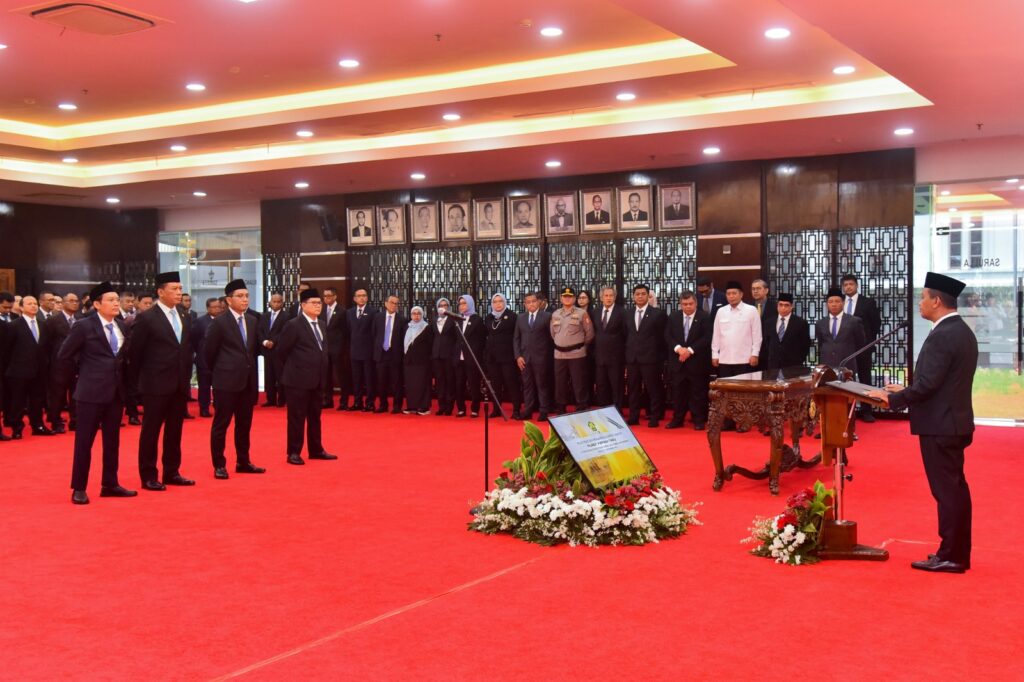
Kelastambang: Energy and Mineral Resources Minister Bahlil Lahadalia appointed several new high-ranking officials within the Energy and Mineral Resources (ESDM) Ministry on Wednesday during an official ceremony at the Chairul Saleh Building, the ESDM Ministry Secretariat in Jakarta.
The appointments included key structural changes across multiple strategic units in the ministry. Prof. Ahmad Erani Yustika was sworn in as Secretary General of the ESDM Ministry, replacing his previous position as Head of the Vice Presidential Secretariat at the Ministry of State Secretariat.
Police Commissioner General Yudhiawan, formerly a senior officer at the National Police Criminal Investigation Department (Bareskrim Polri), was appointed as Inspector General of the ESDM Ministry. Ir. Jisman P. Hutajulu, previously Director General of Electricity, was reassigned to the position of Expert Staff for Strategic Planning. Meanwhile, Dr. Ir. Dadan Kusdiana, who had served as Secretary General of the ESDM Ministry, was appointed as the new Secretary General of the National Energy Council.
In his remarks during the inauguration, Bahlil emphasized that all newly appointed officials must immediately begin implementing key performance indicators (KPIs) aligned with the ministry’s strategic goals.
“We have major tasks ahead, and we must aim to meet the KPIs set by the President, which include increasing lifting, advancing downstream processing, and managing mining operations. Specifically for Prof. Erani, I ask for immediate coordination to accelerate downstream initiatives,” said Bahlil.
He also issued a firm directive to address illegal mining activities, underscoring its urgency to the newly appointed Inspector General.
“Mr. Yudhiawan has an exceptional track record—formerly with the Corruption Eradication Commission (KPK), and regional police chief in both North and South Sulawesi. I ask that he collaborate with the Directorate General of Law Enforcement to resolve issues in mining and oil and gas that must be handled immediately,” he stated.
Bahlil further noted that the rotation of leadership positions is a normal part of institutional management aimed at enhancing organizational effectiveness and strengthening the ministry’s strategic functions.
“Leadership changes are common and are part of role-sharing within an organization, just like in football—there are playmakers, defenders, and strikers, all working toward the same goal. With this philosophy, there should no longer be talk of positions being a promotion or demotion. Everyone plays a role and contributes to national development,” he added.