

KELASTAMBANG: Indonesia’s coal industry continues to play a critical role in supporting national economic growth, contributing significantly to state revenue, domestic energy supply, and industrial downstream development, according to the Ministry of Energy and Mineral Resources (ESDM) during the opening of CoalTrans Asia 2025 in Badung, Bali, on September 22.
Speaking at the event, Tri Winarno, Director General of Mineral and Coal at ESDM, noted that Indonesia holds 97.96 billion tons of coal resources and 31.9 billion tons in reserves, with recent years showing consistently high production levels. “In 2024, we reached our peak coal production at 836 million tons. For 2025, we have set a target of 739 million tons, and as of now, 509 million tons or 68 percent of that target has been achieved,” Tri stated.
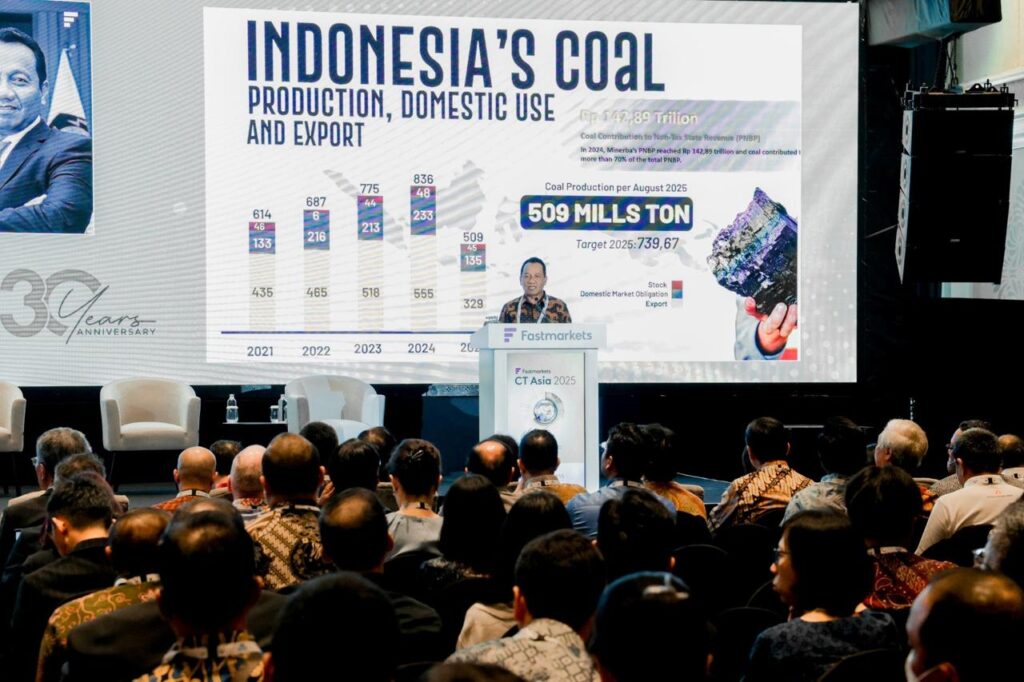
The coal sector remains a major contributor to non-tax state revenue (PNBP), accounting for approximately 70 percent of mining-related receipts. In 2024, the coal industry generated Rp143 trillion in PNBP, with the 2025 target set at Rp123 trillion. When combined with taxes and other levies, the industry’s total contribution to the state budget is estimated to exceed Rp250 trillion.
Beyond its fiscal role, coal continues to serve as a key energy source for domestic industries. Coal-fired power plants support various sectors including cement, pulp and paper, textiles, and mineral processing. Tri highlighted that coal use in smelters, initially recorded at 5 million tons, is projected to rise sharply to over 60 million tons in the coming years.
While the government is committed to reducing reliance on fossil fuels, Tri emphasized that coal will remain part of the national energy mix through cleaner utilization and downstream industrial development. “The downstream industry we envision includes several coal-based sectors. For example, Dimethyl Ether (DME) can substitute imported LPG, of which we bring in around 6 to 7 million tons annually. There is also potential for methanol production. PTBA has initiated humic acid fertilizer development, and other coal-derived industries can follow to support the transition,” he said.
In line with Indonesia’s long-term energy strategy, the government is promoting environmentally responsible coal usage through cleaner technologies and value-added processing. This approach positions coal not only as a fiscal and energy asset, but also as a foundation for industrial transformation during the energy transition.