

KELASTAMBANG: Indonesia’s quartz mining industry is accelerating its push to develop a domestic downstream silica sector, aiming to capture greater value from quartz sand exports amid rising global demand for semiconductor raw materials. The strategic direction was outlined by industry leaders during the International Critical Minerals and Metals Summit held last month in Bali.
Quartz sand, a form of silicon dioxide (SiO₂), is essential to technologies powering the energy transition, including semiconductors, solar panels, and electric vehicles. Industry representatives argue that the material should be classified as a strategic green commodity, supporting its inclusion in national industrialisation priorities.
“Quartz is indispensable to modern life — powering semiconductors, EVs, solar panels, and renewable energy systems. It is not just a raw material; it is the foundation of the green economy,” said Rezki Syahrir, Founder and CEO of PT Silica Quartz Indonesia and representative of the Indonesia Quartz Miner Association (HIPKI), in a LinkedIn post following the event.
According to HIPKI, Indonesia currently ranks 18th in global quartz sand production and accounts for nearly five percent of global exports. Export destinations are led by China, followed by Japan, Chinese Taipei, Canada, and Mexico. Despite this strong trade presence, industry players note that Indonesia lacks capacity in key processing steps of the silica value chain.
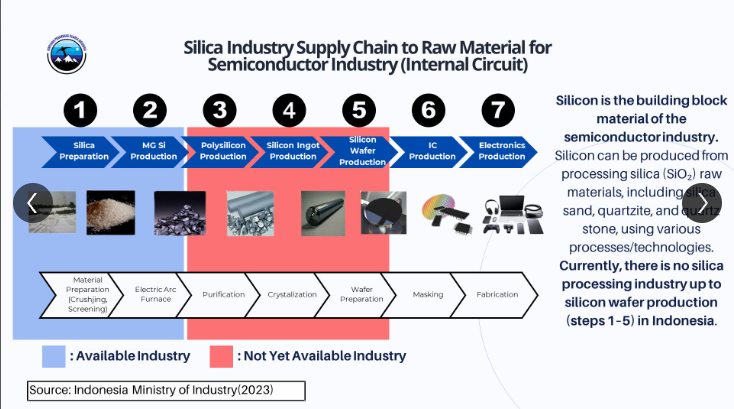
Based on industry data, domestic silica processing is limited to basic crushing and screening (Silica Preparation). There is currently no local capacity for producing metallurgical-grade silicon, polysilicon, silicon ingots, or silicon wafers—intermediate materials essential for semiconductor manufacturing. These gaps span five out of seven stages in the semiconductor supply chain.
“Currently, there is no silica processing industry up to silicon wafer production in Indonesia,” HIPKI stated, referencing a 2023 supply chain analysis. This situation presents both a constraint and an opportunity, particularly as Indonesia grows its critical minerals and technology manufacturing ambitions.
Global demand for quartz sand is projected to grow from 427.2 million metric tons in 2022 to 523.18 million metric tons by 2033, according to market research cited by HIPKI. The market value is expected to rise from US$25.4 billion in 2024 to US$38.3 billion in 2033, representing a compound annual growth rate (CAGR) of up to 4.7 percent.
The industry identifies three primary drivers of growth: the global energy transition, expansion of the glass manufacturing sector, and rising demand from the semiconductor industry.
Despite the export performance, HIPKI argues that Indonesia remains positioned at the lowest rung of the value chain. Quartz sand is shipped abroad in raw form, while the value-added processes—including purification, crystallisation, and wafer fabrication—take place overseas.
“This reflects both a challenge and an opportunity: to move beyond exporting raw materials and become a strategic player in the global semiconductor and clean energy value chain,” Syahrir said.
HIPKI has proposed a shift toward domestic processing and industrial capability development, including infrastructure for silicon ingots and wafer production. The association has participated in recent discussions on strategic investment priorities for 2025, specifically focused on enabling downstream opportunities for quartz and silica.
“It’s inspiring to see the industry aligning with the global green economy—promoting value addition, technological capability, and responsible governance,” Syahrir added.
As one of the world’s top six quartz exporters by volume, Indonesia’s industry players are calling for a transition from raw material supplier to integrated contributor in the global digital and energy infrastructure ecosystem.
“At HIPKI, we are committed to ensuring Indonesia seizes this opportunity responsibly—creating lasting value, driving industrial transformation, and contributing to a sustainable and digital future,” Syahrir stated.
Industry stakeholders continue to advocate for increased investor engagement, technology partnerships, and a national policy framework that recognises quartz as a critical input for downstream manufacturing.